Showing posts with label product review. Show all posts

Tuesday, January 30, 2018

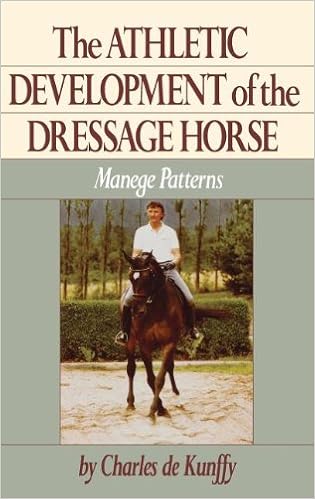
Book Review: The Athletic Development of the Dressage Horse

Title: The Athletic Development of the Dressage Horse: Manege Patterns
Author: Charles de Kunffy
Where to buy it: Used on Amazon

This is my second de Kunffy (and not de Knuffy) book review. After enjoying the last book so much, I browsed through some of his other titles and added this one to my Amazon wish list to pick up later. I still had Bobby at that point, and while he had reached the end of his soundness, I was still holding out hope that I was going to get to ride him again. The thought of having a book with a bunch of dressage exercises to ride through put it on my priority list, but a couple weeks later I had to put Bobby down and I never got around to buying it.

Then I was used bookstore browsing one of the times I was out at my mom's in November and I saw it on their shelves. It was $9, so more than I could have bought it used on Amazon, but I grabbed it anyway. Nine bucks for some de Kunffy wisdom? Sold.

I finally got around to starting it a few weeks ago. I read probably four or five books while trying to slog my way through this one. While I really enjoyed and easily made it through Training Strategies for Dressage Riders, this book felt more like a tedious school assignment.

As in the other book, he starts off philosophizing about generalities of the sport horse. I like reading these insights, and I like that he again points out that the best way for a horse to be a horse is to turn them out and let them interact with each other.

From there he starts talking about training the very young, just-broke horse. I was able to pull some useful points out of this as while Opie is certainly already broke to ride and knows how to balance a rider on his back, he's still very much green broke.

One of them was that horses will volunteer actions that we maybe didn't ask for, but should roll with anyway. "Opportunistic riding" basically installs the thought into the horse that everything he does is "allowed to happen by the rider's will." Does he canter instead of extend the trot? Pick up the wrong lead? A horse that's constantly told No will start to get confused and resent the rider. He's not advocating for letting the horse get away with murder, but reminds the rider to make sure their aids are correct and that the ask isn't beyond the horse's ability. "Riders should correct their own, not the horse's, behavior first."

From there on out, the rest of the book had me dragging my nails down my face. He quickly jumps from a horse that has no training yet to one capable of schooling all the lateral work, pirouettes, and changes. While he does point out the difficulty of these exercises and that you shouldn't attempt them until the horse is ready, I had a hard time staying with it when my own horse is just now getting the concept of two whole steps of leg yield at the trot. I think I would have been able to commit more if I was still riding Bobby and these exercises were pertinent and achievable.

Even so, some of the manege patterns were...well:

excuse me as my eyes cross in confusion 

The writing in this book felt more like a dry, ultra-descriptive, ultra-intense training manual than the friendly read-through vibe the other book gave off. That won't be a problem for a lot of you, but it's not my style of learning at all, and I had a hard time getting the paragraph I had just read to stick in my head.

although there were a couple of not book related
picture pages that i guess were nice to look at?

However, there were still quite a few good gems I was able to pluck out.
  • On how unnatural it is for horses to be ridden. "Both are creatures of precarious balance, even when left alone to cope with the ground." Amen, sir.
  • On collection: "This shifting of the horse's center of gravity towards the haunches liberates his forehand from unnecessarily weight and liberates it from stress. The forelegs being the weaker, riders have learned early the value of saving them and conserving their health." Makes perfect sense of course, but I liked the imagery of this one.
  • "Horses will do almost anything from the rider but read his mind." The rider must make sure they're aiding correctly, judiciously, and clearly. The horse will guess to its best ability, but it can only do what the aids are asking it to.
  • For the spooky horse:

  • "We must remember that it is not sufficient to let the horse move forward, but rather we must ask him to carry forward. ... we ought to insist in our gymnasticizing that the horse move 'forward upward'."
  • It goes against the horse's instincts to move away from leg pressure; they instinctively lean into it. When the rider's calf is correctly wrapped around the horse's barrel, it should rest against the muscles that cause the haunches to react by contracting when stimulated by the rider's leg, therefore increasing the activity in the haunches. Active haunches enable him to move away from the leg pressure. I was able to relate to this a lot with Opie who still struggles with going into my leg sometimes instead of away from it.
  • OMG, never do haunches-in at the canter. The horse loves to use it as an evasion. He brings this up approximated 47,008 times throughout the book.
  • Important that when doing lateral work at the walk to routinely let the horse walk on a loose rein at the free walk to stretch the topline. "Never allow a lazy stroll, but keep a marching attitude."
  • The turn on the forehand encourages the horse to "lean and dwell on the forehand", but it also serves as a useful exercise to get the horse off your leg and moving the haunches. 
  • On lateral work: "Explosive, impatient young horses will not benefit much from these movements... Premature drilling of these exercises can be harmful and can also cause resistence. ... Infinitely delaying more difficult tasks can also be counterproductive in training strategies. Progress can only be made by challenging the status quo." 
The few actual manege patterns in this book don't come until about the last third of the book. I was able to book mark three that I wanted to try when my horse is a little better trained.

I felt like I deserved a good wrap-up for getting through the last training chapter, but instead the book just...ends.

abruptly, the end.

I would recommend this one to riders that have an easy time processing large blocks of detailed information. That person is not me. I'm glad I got through it, but this isn't one that's going to get a re-read from me.

Tuesday, September 12, 2017

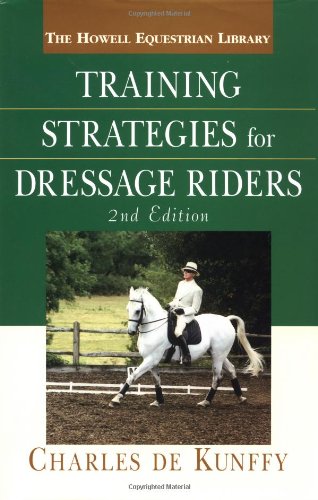
Book Review: Training Strategies for Dressage Riders


Where to buy: Amazon, or there are a couple used copies on eBay

When we were in Maine this summer, we spent one rainy morning driving out to Bangor to try to find a battery charger for my camera. That was a complete fail by the way, but we passed a tack store in our journeys and obviously swung in so it wasn't a complete loss of a trip. Along with my sparkly spur straps, I also perused the consignment section and grabbed a couple of older books for $8 a piece.

One of them was Training Strategies for Dressage Riders by Charles de Kunffy, and I'm so glad I snagged this. It's one of the few training types books I sat down and read from cover to cover instead of flipping through and only reading the sections I thought were relevant to me.

As an aside, I've been living a lie my whole life and totally thought his last name was de Knuffy. Surely I can't be the only one who thought this? Or are my reading comprehension skills really just that poor? Probably the latter.

First of all, the most important takeaway I got from this book is this:

everyone should wear gloves, you savages. 

This book moves along in a fairly chronological order, from an overview on the goals of classical equitation and how to emulate the best riders and their positions to exercises on bending, flexion, and gymnastics for your horse. It wraps up with a look on judging, competition (and how to throw down a proper salute), and the best tack for dressage.

This book was originally published in 1984, and the one I linked to on Amazon is from 2003. I wonder if any of the pictures got updated because one of my favorite parts of this book is seeing young Arthur Kottas and Steffen Peters in pictures.


A few other takeaways I found interesting:

  • The walk. He says many riders neglect the walk for various reasons. Some find it boring, while others feel it's too basic of a gait and is reserved for beginner riders. "Most of us do not 'fall in love' with the art of riding by being attracted to it by the walk. ... Had we desired to creep along at a slow pace, we could have saddled an ox." He also says that insufficient movement during a young horse's growing stages (not enough turnout) can lead to a poor walk. 
  • Changes. "The horse is ready for the flying change if he can maintain elasticity in performing the extended trot, half-passes with cadence at the trot, and collected canter." (Or if you're a racehorse and changes come easier than walking in a straight line, Bobby.) Elasticity is the key, these are just the movements that best show off if your horse has it. 
  • "The Thoroughbred is an excellent horse." Promising, right? Only it's the first sentence for the chapter titled Insubordination of Horse to Rider. That made me LOL. He goes on to say that while Thoroughbreds are the embodiment of athleticism, it's that very thing that makes them more difficult as a dressage prospect. They're so sensitive and can carry a past with a lot of baggage which makes the relaxation part of dressage not come easily to them. 
  • Bits. "The most gentle and therefore the most appropriate bit is a simple jointed snaffle. ... A bit with only one joint in the center is recommended." SUCK. IT. I can't stand reading people harp about how a single jointed snaffle is abuse and so harsh and yada yada. French links aren't for everyone. Bobby hates having any sort of middle piece to his bits and has always gone best in a simple single joint. 
I've also gone back and re-read his section on the double now that we're starting to play with one a little bit. "The use of the full bridle must be earned by the horse and deserved by his rider." I've been reading everything I can find about the double lately because I'm kind of afraid of it still, but I thought it was funny that in this older book he preaches the use of 3-1 reins which is now considered completely out-dated.

looks way too confusing to me

Overall this is one of those books that sits on my side table instead of in my bookcase. Its extensive list of exercises and problem solving is something I keep coming back to, and his chapters on equitation always give me a kick in the ass to sit the fuck up and sit the fuck down. (Then I get sloppy and have to go back and read them yet again because dressage is hard.)


I wholeheartedly recommend this to anyone interested in dressage from a basic level to those who have a real interest and passion in it. There's something for everyone, and it's an easy, engrossing read.

Monday, January 9, 2017

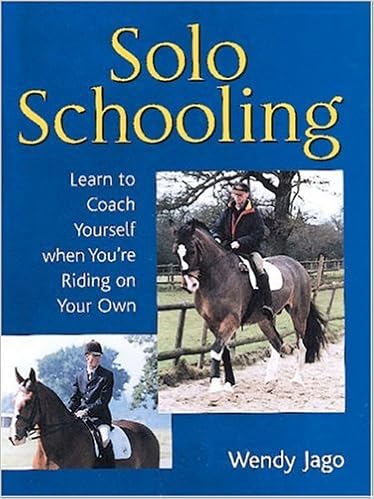
Book Review: Solo Schooling

Title: Solo Schooling: Learn to Coach Yourself When You're Riding on Your Own
Author: Wendy Jago
Buy it: Used on Amazon


I bought this book used last year for my birthday with an Amazon gift card. I didn't really read the description or research anything about it. It had been sitting in my wish list for a couple years based solely on its title. Solo schooling? Self policing your rides? I'm all about mental exercises to try to improve my rides, and since I spend most of my time riding alone, this book seemed like it was made for me.

Spoiler alert: It wasn't.

I started it as soon as I got it, but I was immediately bogged down by the writing. I flipped through it and didn't actually see anything that I wanted to dive into. It got set aside...and never opened again until this past weekend. I was between books and it was brutally cold outside so I decided I was going to just sit down and conquer it with a blog review being my biggest motivator to finish it this time around.

The book is basically a giant two hundred page sales brochure for a program called NLP--Nuero-Linguistic Programming. From what I understand, this program wasn't created specifically for equestrians, and while there are examples in every chapter that tie it into the horse world, they all feel like a stretch and didn't do a particularly good job of explaining anything further.

NLP is basically an exploration of how people think, behave, and interact to learn.

Each chapter is broken down into blocks so that you can learn what type of person you are. Do you learn best this way or that way? Do you look at a problem like this or like that? You essentially go through more than half the book trying to figure that out, and then set up your "meta-program" so that you can take it to your NLP coach who now knows how to best teach you.

If you're now like, "Wait, take it to your coach? Aren't you supposed to be solo schooling?" Don't worry. I was confused, too. In fact, I still am. Over and over, the book advises that when you run into a problem, go to your coach with it, or have a friend watch and help you dissect what's going on.

The writing was incredibly dry, and I had a hard time wrapping my head around what I was reading. It felt more like really bad homework than an interesting equestrian training manual. If you're an incredibly detail specific person, or someone that deals with cut and dry business documents on a daily basis, you'd probably have an easier time not getting overwhelmed with this book, but I was hoping for something a little more light.

If you can manage to break it down though, there are some really interesting points interspersed:

  • Performance = Potential - Interference
  • Presuppositions: Don't go into something with only one mindset about how that situation will play out. "My horse is lazy. I have to get him forward so I'll give him a kick, but now he's just fast and strung out." Instead: "My horse isn't forward today. Maybe it's because of the long ride we had yesterday. Let me loosen him up at a slower pace first before asking him to go more forward."
  • Make choices that fit you. If you think that fence is too high, don't let someone's outside opinion influence you to jump it, and then you get dumped. However, go outside your comfort zone into your "stretch zone", or you'll never move forward.
  • Framing things: For example, eventers see dressage as a phase they just want to get over with when all it is is getting your horse "obedient, balanced, on the aids, and changing speed and stride-length rapidly." It's just like jumping but without the jumps, so frame it that way in your mind and you won't psych yourself out over it. 
  • Don't get caught in behavioral traps: Playing it safe, not being in the moment, and/or getting stuck in repetition.
  • Ask better questions: Instead of just saying, "That halt was bad." ask yourself why. Did his haunches move out? If yes, did you have your legs on evenly or did you come in unbalanced? Did he throw his head? If yes, did you pull on the reins and not ride him forward into it? Did you half halt correctly?
Towards the end of the book, there's one chapter that I was able to relate to the most because it had the most to do with riding alone. That's where the asking better questions comes in, and it talks about being flexible and working with your horse if your chosen plan for the day doesn't look like it's going to go the way you want it to. 


Overall? One and half thumbs down. Not something I'd recommend to fellow riders, especially those looking to improve their own actual solo schooling.